Submarine Cable Manufacturer — HVAC, HVDC & Dynamic Marine Cables
Power, HVDC, Fiber Optic & Dynamic Marine Cable | Engineered for Offshore Wind, Oil & Gas Platforms, Inter-Island Power Links and Subsea Telecommunications
HVAC up to 500kV | HVDC up to 525kV | Water Depth: up to 3,000m Rated Armour | IEC 60840 · IEC 62067 · IEC 60502 Certified | DNV · Bureau Veritas · Lloyd's Register | Single-Wire & Double-Wire Armour Available
Our Submarine Cable Products
Submarine Cable Catalogue PDF
ZMS provides our partners around the world with brochures of our cable products, including aerial cables, submarine cables, control cables and other types of special cables, and more.
ZMS submarine cables are engineered for reliability in the world’s most demanding marine environments. Click any product type to explore technical specifications, available constructions, and project documentation.
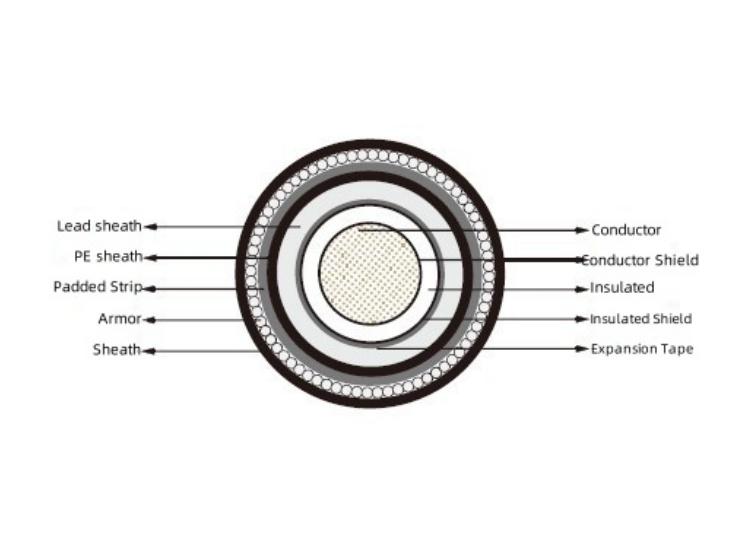
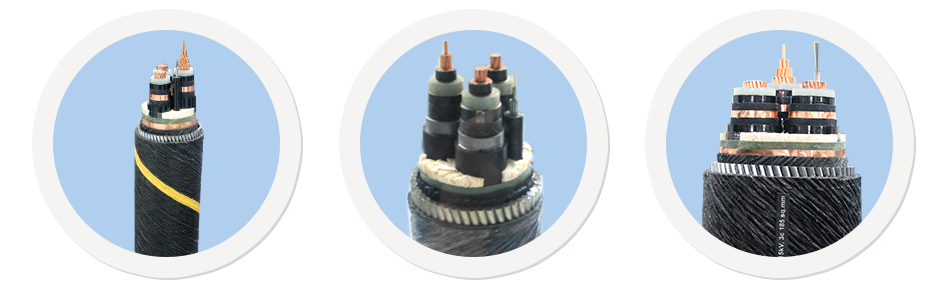
XLPE or EPR insulated submarine power cables for inter-island power links, offshore platform supply, river crossings, and export connections for offshore renewable energy. Three-core construction for voltages up to 132kV; single-core for 220kV and above. Galvanised steel wire armour rated for water depths up to 1,000m (standard) or 3,000m (deep-water version).
Voltage/Specification Range: HVAC 3.6/6kV – 127/220kV; Cross-sectional area 70–2,500mm²
Certification Standards: IEC 60502; IEC 60840; IEC 62067
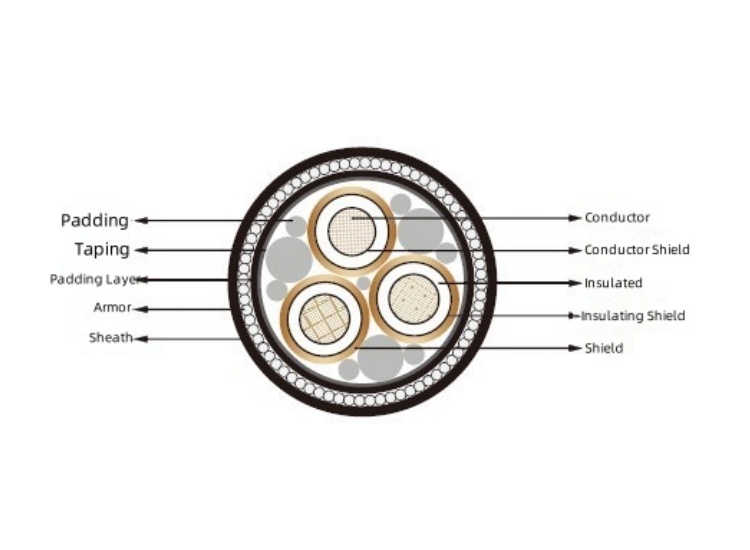
Mass-impregnated (MI) and XLPE-insulated HVDC submarine cables for long-distance bulk power transmission across seas and straits. HVDC submarine cables carry power with significantly lower losses than HVAC over distances exceeding 80km. Available in bipole and monopole configurations up to 525kV DC.
Voltage/Specification Range: HVDC Up to ±525kV DC, cross-sectional area 630–2,500mm²
Certification Standards: IEC 60840 IEC 62067 CIGRE TB-490
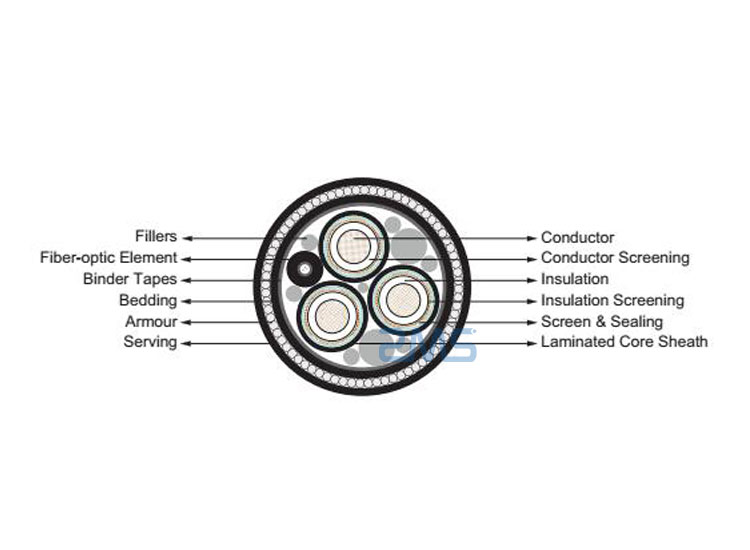
Submarine fiber optic cables for inter-continental telecommunications, inter-island broadband links, offshore platform data transmission, and real-time offshore wind turbine monitoring. Armoured lightweight (LW), single armour (SA), and double armour (DA) types for different water depths and burial protection requirements.
Voltage/Specification Range: Single Mode (G.652 / G.654) Fiber count: 2–144 cores
Certification Standards: IEC 60794-4 ITU-T G.652 ITU-T G.654
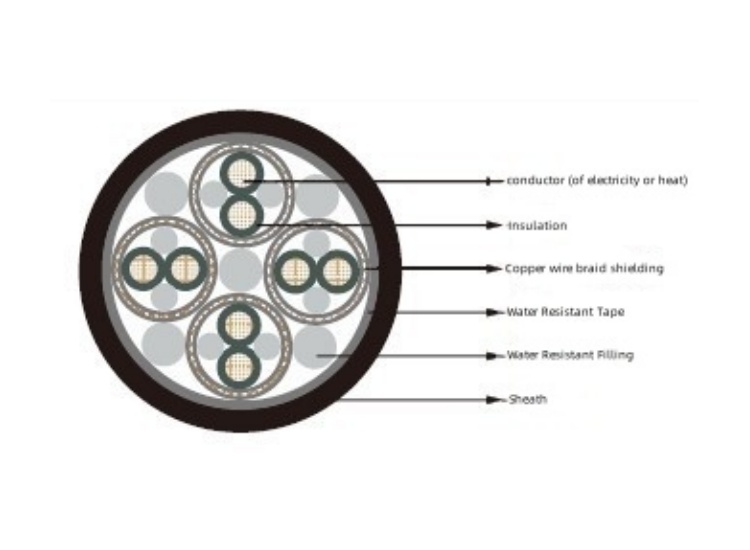
Dynamic marine cables are designed for applications where the cable must flex continuously with wave motion, platform movement, or tidal action. Used for floating offshore wind turbines (FOWT), FPSOs, semi-submersible platforms, and wave energy converters. High fatigue resistance with bend restrictor and I/J-tube installation support.
Voltage/Specification Range: Up to 66kV (FOWT typical) Cross-sectional area 35–400mm²
Certification Standards: IEC 60092 DNV-ST-0359 ABS / BV
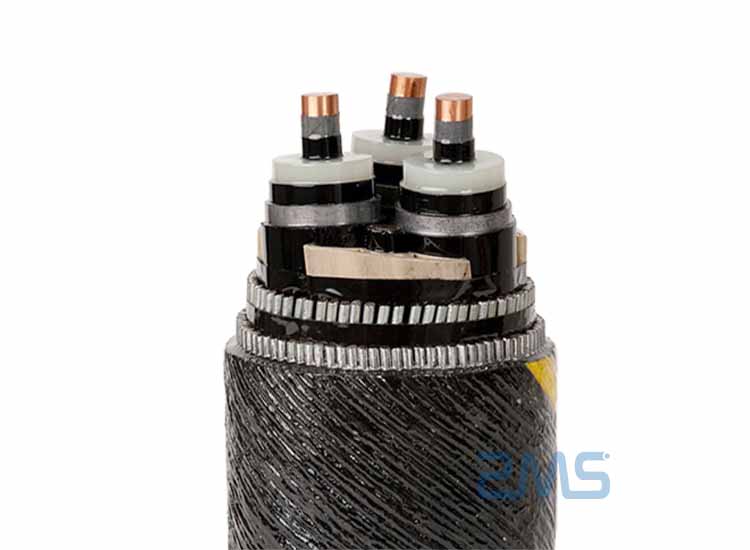
Submarine Power Cable Construction – Layer by Layer
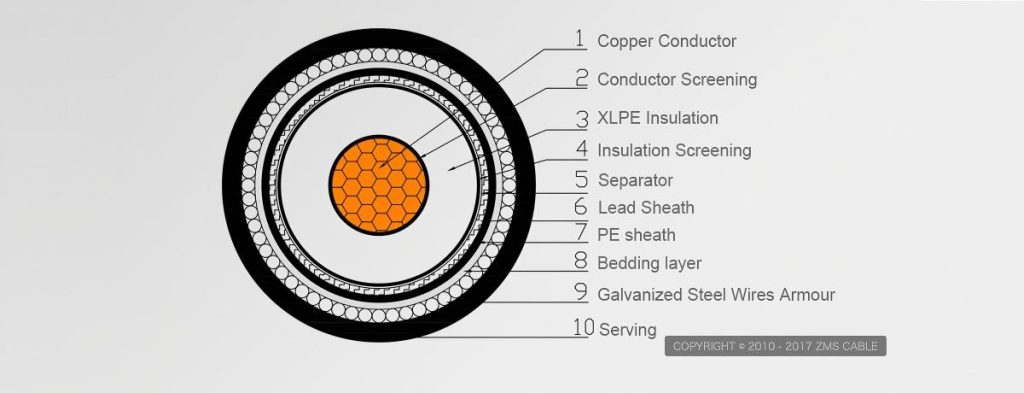
Submarine Cable Armour Selection Guide
Armour Type | Code | Construction | Max Water Depth | |
|---|---|---|---|---|
Lightweight | LW | Single-layer galvanized steel wire, thin diameter | 1,000–3,000 m | Deep-water telecom sections where anchor / fishing risk is negligible |
Single Armour | SA | Single-layer galvanized steel wire, standard | 200–1,000 m | Continental shelf, inter-island links, nearshore power transmission — the most common type |
Double Armour | DA | Two layers of counter-helically wound galvanized steel wire | 800–3,000 m | Deep-water oil & gas, strong-current areas, rocky seabeds, high mechanical load |
Double Armour — Burial Grade | DA-B | Heavy double armour + outer PP rope serving | 0–200 m (nearshore) | Buried nearshore sections, harbors, estuaries, intertidal zones — anchor & trawl protection |
Unarmoured | — | No steel wire; HDPE outer sheath only | <50 m (platform jumper) | Short inter-platform jumpers (<50 m), J-tube internal cabling, no seabed exposure |
Submarine Power Cable – Reference Specifications
Rated Voltage | Cross-section Range | Outer Ø (approx.) | Weight (approx.) | Max Water Depth | Armour Grade | Standard |
|---|---|---|---|---|---|---|
3.6/6 kV | 70–300 mm² | 80–130 mm | 15–35 kg/m | 500 m | SA | IEC 60502-2 |
6/10 kV | 95–400 mm² | 90–150 mm | 18–45 kg/m | 500 m | SA | IEC 60502-2 |
8.7/15 kV | 95–400 mm² | 95–155 mm | 20–48 kg/m | 800 m | DA | IEC 60502-2 |
12/20 kV | 120–400 mm² | 100–160 mm | 22–50 kg/m | 800 m | DA | IEC 60502-2 |
18/30 kV | 150–500 mm² | 110–175 mm | 26–60 kg/m | 1,000 m | DA | IEC 60502-2 |
26/35 kV | 185–630 mm² | 125–195 mm | 32–75 kg/m | 1,000 m | DA | IEC 60840 |
64/110 kV | 240–800 mm² | 150–230 mm | 45–110 kg/m | 1,500 m | DA | IEC 60840 |
76/132 kV | 400–1,000 mm² | 170–260 mm | 55–140 kg/m | 2,000 m | DA | IEC 60840 |
Rated Voltage | Configuration | Cross-section | Insulation | Max Water Depth | Armour | Standard |
|---|---|---|---|---|---|---|
127/220 kV HVAC | 3 × single-core | 630–2,500 mm² | XLPE | 1,500 m | DA | IEC 62067 |
190/330 kV HVAC | 3 × single-core | 1,000–2,500 mm² | XLPE | 2,000 m | DA | IEC 62067 |
290/500 kV HVAC | 3 × single-core | 1,600–2,500 mm² | XLPE | 2,000 m | DA | IEC 62067 |
±320 kV HVDC | Monopolar or bipolar | 1,000–2,500 mm² | MI paper or XLPE | 2,000 m | DA | IEC 62067 / CIGRE TB-490 |
±525 kV HVDC | Monopolar or bipolar | 1,600–2,500 mm² | MI paper or XLPE | 3,000 m | DA | IEC 62067 / CIGRE TB-490 |
- IEC 60502-2 — MV submarine power cables, U₀/U up to 26/35 kV (Um = 36 kV)
- IEC 60840 — HV submarine power cables, 30 kV to 150 kV
- IEC 62067 — EHV submarine power cables above 150 kV, and extruded HVDC cables
- IEC 60228 — Conductor specifications (class and resistance requirements)
- CIGRE TB 490 — Design and testing recommendations for HVDC extruded cable systems
- DNV (Det Norske Veritas) — North Sea oil & gas, Nordic offshore wind, FPSO projects
- Bureau Veritas (BV) — French and African offshore projects, global oil & gas platforms
- Lloyd's Register (LR) — UK, Commonwealth, and GCC offshore projects
- ABS (American Bureau of Shipping) — American offshore projects, Gulf of Mexico
- DNV-ST-0359 — Design and certification of dynamic submarine cables for floating offshore wind
- IEC 60092-376 — Power cables for ships and offshore units
- API RP 17B — Flexible pipe and umbilical design reference (petrochemical industry)
Submarine Cable Applications
Offshore Wind Farm Export Cables
Inter-Island Power Links
Offshore Oil & Gas Platforms
Floating Offshore Wind (Dynamic Cables)
Strait & River Crossings
Why Choose ZMS Cable?
Cable Customization
ZMS submarine cables are manufactured by GB, IEC, and other international standards and include a wide range of industry applications, but sometimes it is necessary to customize the cable or customize the cable solution according to the needs of the application. You can provide the specifications, cross section area, dimensions, materials, etc. of the undersea cable that needs to be customized. Our technical team can work with you to customize the cable to meet your specific application needs.
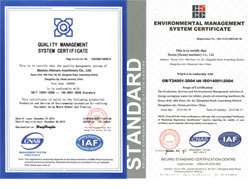
ZMS Qualification
ZMS has been qualified by the ISO 9001, OHSAS 18001, and ISO 14001 systems successfully. The whole quality assurance system covers the design and engineering, raw material selection, manufacturing, FAT, load out, and also the service for site testing and maintenance. The submarine power cable has been qualified by different kinds of Reports and certificates according to IEC, ICEA, and CIGRE standards: e.g. KEMA type test report, Type test report issued by SECRI in Shanghai, DNV, BV, SGS inspection report, etc.
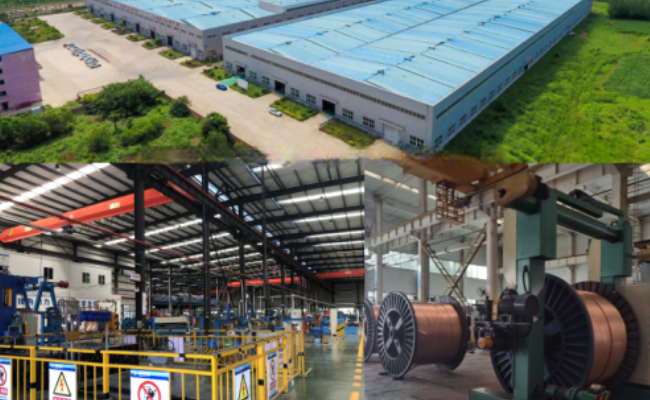
Experienced Manufacturer
ZMS can also offer cables with different sheathing, screening, taping & armoring options as per customer’s specific requirements. we can also offer cables suitable for superior fire performance characteristics as well as with low smoke & fume (LSF or LOSH/LOZH) properties. special features like longitudinal water sealing of conductors & cu screens, radial water sealing of cu screens as well as different colours of outer sheath can be provided on request.
FAQ – Submarine Cable
HVAC (High Voltage Alternating Current) submarine cables transmit power using alternating current at standard grid frequencies (50Hz or 60Hz). They are available in three-core configurations up to 132kV and single-core for 220kV to 500kV. HVAC cables are simpler, lower cost, and use standard grid equipment at both ends. However, HVAC cables have significant reactive power generation (charging current) that limits their economical transmission distance to approximately 50–80km depending on voltage level. HVDC (High Voltage Direct Current) submarine cables transmit power as direct current, eliminating reactive charging current and enabling efficient transmission over hundreds or thousands of kilometres with no technical length limit. HVDC requires converter stations at each end, which adds significant cost. HVDC submarine cables are the standard choice for distances over 80km, large-scale offshore wind farm connections to shore, and inter-continental power links. ZMS supplies both HVAC submarine cables and HVDC submarine cables to IEC 62067 and CIGRE standards.
The maximum operating water depth for a submarine cable depends on the armour type and the tensile load during installation and operation. As a general guide: Single Armour (SA) submarine cables are rated for water depths up to 500–1,000m for standard configurations and up to 1,500m for heavy single armour. Double Armour (DA) submarine cables are designed for water depths of 800m to 3,000m. Lightweight (LW) armour is used for deep water sections in telecommunications submarine cables, typically beyond 1,000m where mechanical damage risk from anchors and fishing gear is negligible. For oil and gas platform cables installed at depths of 100–3,000m, the cable must also withstand dynamic loading from platform movement — these require dynamic marine cable design with enhanced fatigue resistance. ZMS can supply cables for all water depths. Please provide your project water depth profile and installation method (burial or surface lay) for a specific armour recommendation.
A dynamic submarine cable (also called a dynamic marine cable) is designed to flex continuously and repeatedly without fatigue failure, unlike a static submarine cable that is laid on the seabed and remains stationary. Dynamic cables are required whenever the cable must move with the structure it is connected to, including floating offshore wind turbines (FOWT), FPSOs (Floating Production Storage and Offloading vessels), semi-submersible drilling platforms, and wave energy converters. The cable must withstand millions of flex cycles over a 25–30 year design life under combined effects of wave motion, current, and tension. Dynamic cables use specially designed conductor construction (fine-wire stranding), fatigue-resistant insulation and sheath compounds, and are often installed with bend restrictors, buoyancy modules, and I-tube or J-tube connectors at the floater interface. Design and certification typically follows DNV-ST-0359 or IEC 60092-376. ZMS supplies dynamic marine cables for floating offshore applications.