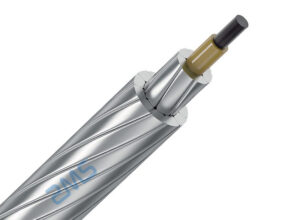
ACSS Conductor
ACSS (Aluminum Conductor Steel-Supported) is an HTLS conductor built with fully annealed 1350-0 aluminum strands over a galvanized or Galfan steel core. Because the steel core carries the full mechanical load, ACSS operates continuously at 200 °C (short-time 250 °C) with no loss of strength. It sags less than ACSR at high temperatures and is unaffected by long-term aluminum creep — making it ideal for line uprating and new transmission projects.
ACSS Conductor Construction & Standards
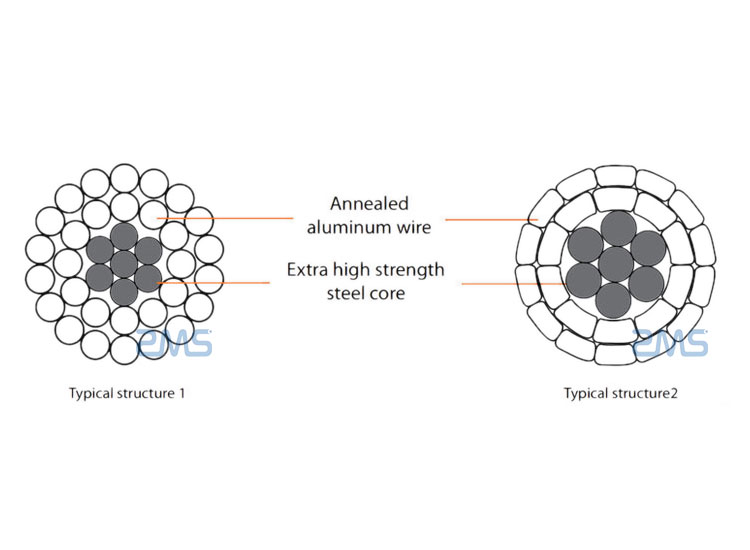
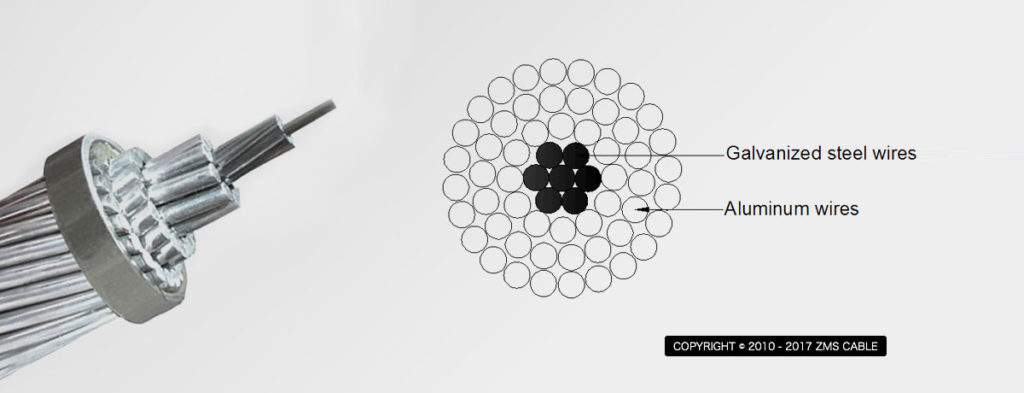
ACSS (Aluminum Conductor Steel-Supported) consists of fully annealed 1350-0 aluminum strands over a zinc-coated (galvanized) or Zn-5% Al Mischmetal (Galfan) steel core. The steel core carries nearly all the mechanical tension, allowing the annealed aluminum to carry current without contributing to strength.
Construction options:
- Round wire (ACSS) — standard concentric stranding, round aluminum wires
- Trapezoidal wire (ACSS/TW) — shaped aluminum wires for a more compact cross-section, ~10% more aluminum area per outer diameter
Manufactured to:
Conductor standard | IEC 61089 (round wire concentric lay), IEC 62219 (HTLS conductors), ASTM B856 (ACSS) |
Aluminum wire | ASTM B609 (1350-O aluminum, annealed temper) |
Steel core | ASTM B802 (Galfan), B803 (high-strength Galfan), B857 (galvanized) |
We supply ACSS with standard galvanized, Galfan, or aluminum-clad steel cores, depending on corrosion environment. Custom stranding and special lengths available.
Why Choose ACSS Conductor?
– Runs hot without sagging — continuous 200 °C operation, with sag similar to ACSR at normal temperature
– No aluminum creep — final sag stabilizes after first thermal cycle, no long-term creep elongation
– Reconductoring without new towers — uprate existing lines with minimal or no structure modification
– Higher ampacity — annealed aluminum has higher conductivity than hard-drawn; 1.5–2× current vs same-diameter ACSR
– Withstands emergency overload — short-time 250 °C rating for contingency loading
– Corrosion options — galvanized, Galfan, or aluminum-clad steel core for coastal/industrial environments
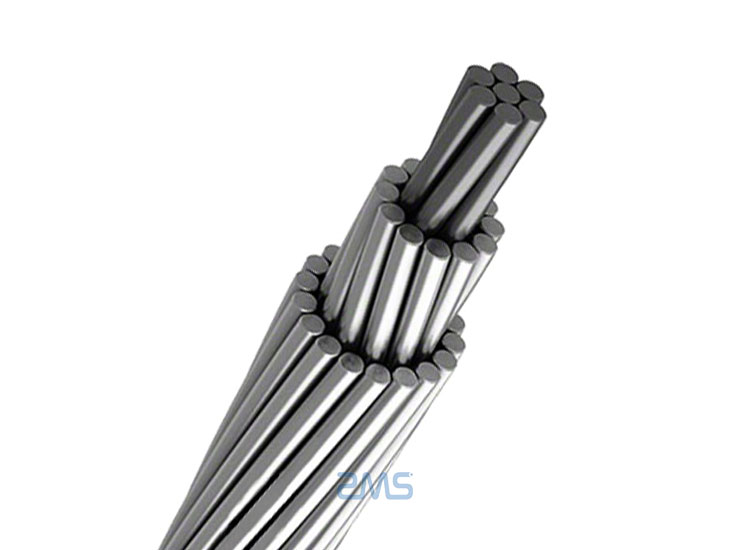
ACSS vs ACSR — What's the Difference?
ACSR (Aluminum Conductor Steel Reinforced) uses hard-drawn (temper H19) aluminum over a steel core. The aluminum contributes to both electrical conduction and mechanical strength, so it can only run continuously at 75–90°C before it anneals and loses strength.
ACSS uses fully annealed (1350-O) aluminum over the same type of steel core. Because the steel core carries all the mechanical load, the annealed aluminum can run at 200°C continuously without losing strength. This is why ACSS is the standard choice for line uprating.
ITEM | ACSR | ACSS |
|---|---|---|
Aluminum temper | Hard-drawn (H19) | Annealed (1350-O) |
Continuous temp | 75–90 °C | 200 °C |
Short-time temp | 100 °C | 250 °C |
Sag at high temp | Increases significantly | Minimal |
Creep | Long-term aluminum creep | Stabilized after first cycle |
Cost | Lower | Slightly higher |
Best for | New lines, standard loading | Uprating / high-temperature / emergency load |