In European construction projects, cable fire safety is not an optional standard, but a mandatory regulatory requirement. The EU Construction Products Regulation (CPR), standardized by EN 50575:2014+A1:2016, mandates that all power, control, and communication cables installed in building and civil engineering works must undergo fire reaction classification testing and labeling before market access and on-site application .
With seven hierarchical fire reaction grades from Aca (highest non-combustible level) to Fca (lowest flammable level), the CPR classification system directly determines cable application scenarios, fire risk resistance, and project compliance. For engineering purchasers, construction contractors, and electrical designers, accurately matching CPR cable ratings to project requirements is the core key to ensuring building fire safety and passing EU regulatory inspections. This article will systematically interpret the full set of CPR cable fire classifications, core performance indicators, and scenario-based selection guidelines to help you select compliant and cost-effective cables for your projects.
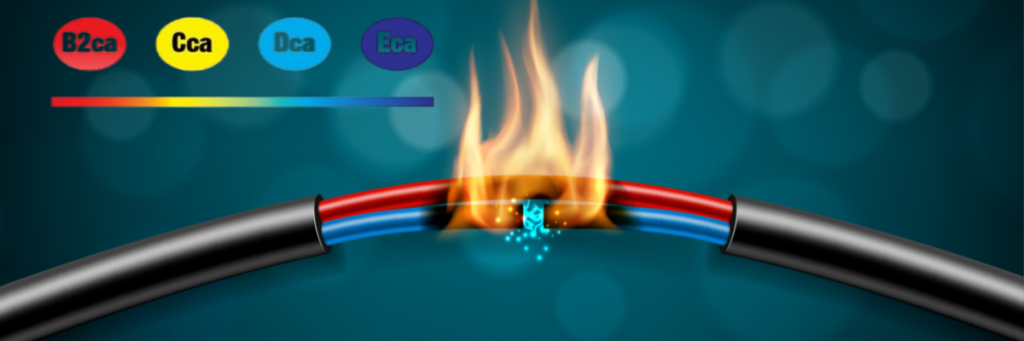
Overview of EU CPR Cable Fire Regulation
Officially enforced in July 2017, the EN 50575 standard completely unifies the fire reaction evaluation system for construction cables across EU member states, replacing scattered national fire protection standards. Different from fire-resistance cables that focus on maintaining circuit integrity in fires, CPR classification targets fire reaction performance—the cable’s combustion behavior, flame spread, heat release, smoke generation, and harmful substance release when exposed to fire sources .
The core purpose of CPR classification is to control the secondary hazards of cables in building fires: preventing cables from becoming fire spread channels, reducing dense smoke and toxic gas diffusion, and avoiding molten droplets igniting secondary combustibles. It applies to all cable products used in fixed installation of European construction projects, covering power cables, control cables, communication cables, and building wiring cables . Notably, although the EU has unified classification standards, individual member states may set minimum rating thresholds according to local building fire codes, which needs to be combined with project regional requirements for selection .
Full Interpretation of CPR Cable Fire Classification System
The CPR fire reaction classification system includes 7 core grades, with performance decreasing sequentially from Aca to Fca. Each grade corresponds to strict quantitative test indicators covering heat release rate, flame spread range, total heat release, smoke production, burning droplets, and acidity of combustion products. Meanwhile, the system supports auxiliary grading labels, s: smoke performance, d: droplet performance, and a: acidity performance, to fully define comprehensive fire safety performance.
The following table lists the detailed performance parameters and characteristics of each grade of ZMS cable, based on official data:
| CPR Rating | Core Performance Characteristics | Key Test Indicators (Core Thresholds) | Auxiliary Grading Scope | Fire Risk Level |
| Aca | Non-combustible highest grade, no combustion reaction, no heat release, no flame spread | No combustible reaction under standard fire source, zero heat release, zero flame spread | No auxiliary grading required | Extremely low (non-flammable) |
| B1ca | Extremely flame-retardant, minimal heat release, almost no flame spread, excellent smoke suppression | FIGRA ≤ 120W/s, Peak HRR ≤ 20kW, THR1200s ≤ 10MJ, flame spread ≤ 1.75m | s1/s2, d0/d1, a1/a2 | Ultra-low |
| B2ca | High flame-retardant, weak flame spread, low heat release, stable combustion performance | FIGRA ≤ 150W/s, Peak HRR ≤ 40kW, THR1200s ≤ 20MJ | s1/s2, d0/d1, a1/a2 | Very low |
| Cca | Medium flame-retardant, limited flame spread, controllable heat release, suitable for conventional fire protection scenarios | FIGRA ≤ 300W/s, Peak HRR ≤ 60kW, THR1200s ≤ 40MJ | s1/s2/s3, d1/d2, a1/a2/a3 | Low |
| Dca | Basic flame-retardant, flame spread and heat release within acceptable range for ordinary buildings | Meet basic flame retardancy, no large-area flame spread, no continuous combustion | s2/s3, d2, a2/a3 | Medium |
| Eca | Minimum compliant grade, basic fire resistance, limited anti-spread ability | Resist short-time flame erosion, no rapid flame spread | s3, d2, a3 (default) | Medium-high |
| Fca | Non-compliant grade, flammable, unqualified fire reaction performance, no test certification | Fail all graded test indicators, no fixed performance thresholds | No auxiliary grading | Extremely high |
Key Indicators for Interpretation
Based on core grades, CPR auxiliary grading further refines cable fire safety performance, providing a crucial basis for high-standard project selection. The three core auxiliary indicators cover smoke, droplet, and acidity performance:
Smoke performance (s series): Divided into
– s1 (low smoke density, minimal smoke generation)
– s2 (medium smoke)
– s3 (unlimited smoke).
High-standard public buildings and underground spaces must use S1-grade cables to ensure fire escape visibility.
Burning droplet performance (d series): Divided into
– d0 (no burning droplets)
– d1 (no continuous burning droplets)
– and d2 (allow burning droplets).
d0 grade is mandatory for flammable material laying areas to prevent secondary fire hazards.
Acidity performance (a series): Divided into
– a1 (low acidity, low corrosion)
– a2 (medium acidity)
– a3 (high acidity). Low-acid a1/a2 cables can avoid corrosion damage to building equipment and circuit secondary failure in fires.
Project Scenario-Based CPR Rating Selection Guide
The core principle of CPR cable selection is matching grades with project fire risk. Excessively high grades increase costs, while insufficient grades lead to non-compliance and fire hazards.
The refined selection rules for mainstream scenarios are as follows:
Aca Grade
Made of special materials such as mineral insulation, with absolute non-combustibility .
Suitable for ultra-high-risk core scenarios: nuclear facility supporting circuits, high-rise building fire control power circuits, tunnel key signal lines, and special industrial explosion-proof projects.
It is the highest safety grade with high material and construction costs.
B1ca/B2ca Grade
High flame-retardant and low-smoke non-halogen series, the preferred grade for high-standard public buildings. Applicable to large shopping malls, hospitals, schools, subway stations, underground garages, and dense crowd gathering spaces.
These scenarios require strict control of flame spread and smoke diffusion to ensure personnel escape time.

Cca/Dca Grade
Cost-effective conventional flame-retardant grades, covering most civil and commercial building scenarios. Suitable for ordinary office buildings, residential buildings, factory workshops, and conventional power distribution circuits, meeting basic building fire protection design requirements.
Eca Grade
The minimum compliant grade is only applicable to low-risk open spaces with low fire load and sparse personnel, such as outdoor simple temporary facilities and open-air pipeline laying. It is prohibited in enclosed building spaces.
Fca Grade
Completely non-compliant with EU construction standards, strictly prohibited from being used in all fixed construction installation projects, and only applicable for temporary non-construction civil wiring.
Common Compliance Misunderstandings & Practical Suggestions
In actual project bidding and construction, many enterprises face compliance risks due to unclear CPR grading rules. First, distinguish between fire reaction (CPR grading) and fire resistance: CPR evaluates cable combustion performance, while fire resistance evaluates circuit integrity under fire. Fire-resistant cables also need to pass CPR fire reaction grading to be put into use .
Second, avoid “one-grade-for-all” selection. Many projects blindly pursue high-grade B1ca cables, resulting in cost waste; while low-risk projects using ungraded Fca cables will face order rejection and project rectification. It is recommended to formulate grading selection schemes according to local EU member state building codes and project fire risk classification.
In addition, pay attention to the validity of certification: CPR cables need to pass regular factory audits and full-item retesting (System 1+ for high grades) to ensure long-term compliance of product performance . When purchasing, verify the EN 50575 test report and CPR classification label to avoid unqualified counterfeit products.
EU CPR cable fire classification is a standardized, scientific fire safety evaluation system covering all construction cable scenarios. From Aca non-combustible ultra-high safety performance to Fca unqualified flammable grade, each grade has clear performance boundaries and application positioning. For cable suppliers and engineering contractors, mastering CPR grading rules and scenario matching logic is not only the basic requirement of EU market access, but also the core guarantee of project fire safety and compliance delivery. Reasonable selection of CPR-rated cables can balance safety, compliance and cost, and provide reliable electrical support for European construction projects.