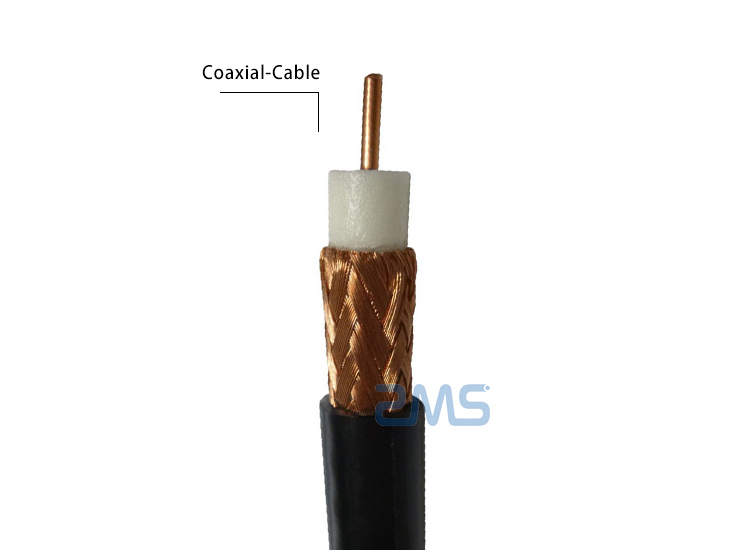
Coaxial Cable
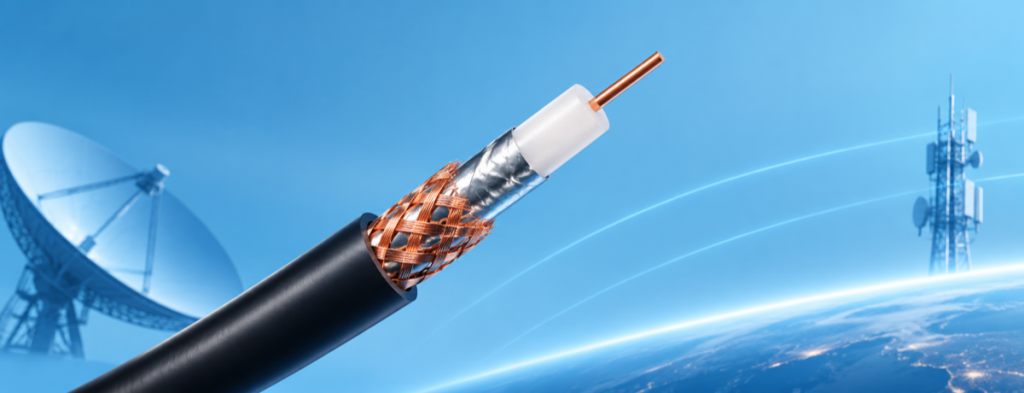
Coaxial cables transmit radio frequency (RF) signals with low loss and high noise immunity. We manufacture a complete range of 50 Ohm and 75 Ohm coaxial cables for CATV distribution, CCTV, two-way radio, microwave links, and test instrumentation. Our RG series includes RG58, RG142, RG213, RG6, RG59, and MIL-DTL-17 compliant cables, with oxygen-free copper conductors and PVC, PE, or LSZH jackets. Custom lengths, armoring, and shielding options available.
Description of ZMS Coaxial Cable
M17 / RG Series Coaxial Cable (50 Ohm & 75 Ohm)
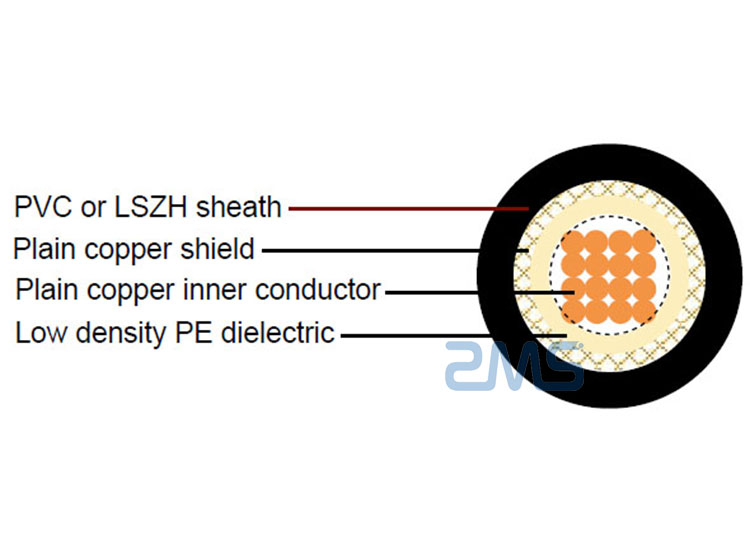
The M17/RG series covers the standard RG coaxial cable range for RF and video applications, with low attenuation and low signal distortion up to GHz frequencies. Low-density polyethylene dielectric provides low loss and good flexibility. RG58 is widely used for instrument connections, two-way radio, and test equipment. RG6 and RG59 are standard for CATV and CCTV.
Standard: MIL-DTL-17 (formerly MIL-C-17)
50 Ohm models:
Model | Application |
|---|---|
RG58 / RG58A/U | Two-way radio, test equipment, instrument connections |
RG142 / RG142B/U | MIL-spec, high-temp applications, double shield |
RG213 / RG213/U | Power RF, antenna feeders, higher power handling than RG8X |
RG223 / RG223/U | MIL-spec, double braid, high performance |
RG303 / RG304 | Semi-rigid, high-frequency test |
75 Ohm models:
Model | Application |
|---|---|
RG6 / RG6/U | CATV, satellite, CCTV video |
RG59 / RG59/U | CCTV, short video runs |
Twin RG6 / Twin RG59 | Dual-coax for video + power |
Triaxial Cable Series
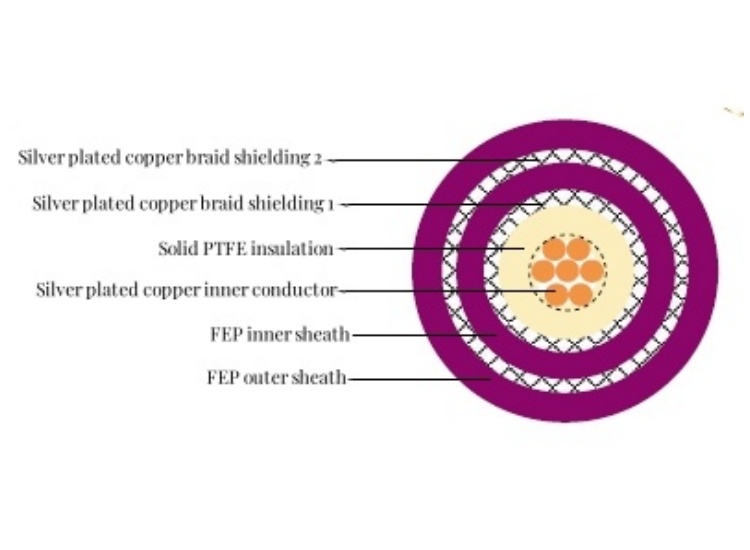
Triaxial cables (triax) are similar to coaxial cables but add a third conductor layer — an outer shield separated by an additional insulation layer. This provides better noise rejection and wider bandwidth than standard coax, making triax ideal for high-end video and camera control applications. The most common use is connecting PTZ (pan-tilt-zoom) cameras to control equipment, transmitting video and control signals over one cable.
Conductor: Tinned copper
Jacket: PVC (yellow)
Standard: MIL-DTL-17
Models: Tri-RG179, Tri-RG180, Tri-RG316, CTX 41, CTX 44 Flex, CTX 47 Flex, CTX 64
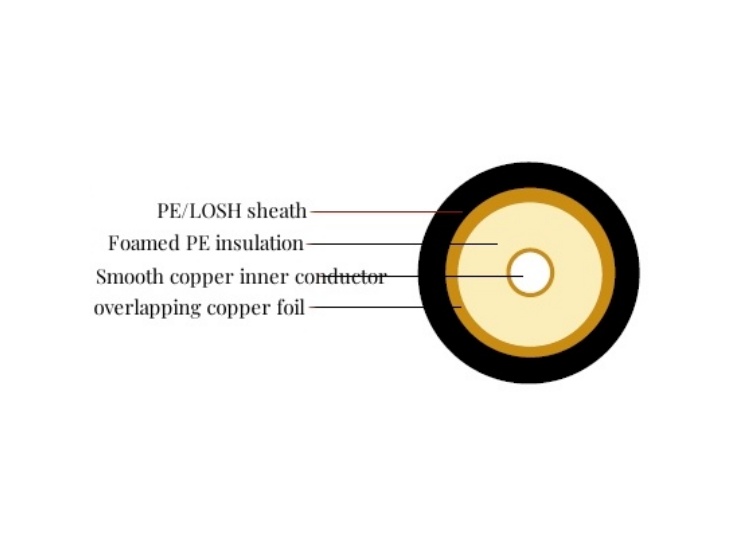
50 Ohm Wideband Feeder Cable
Feeder cables (also called hardline or RF feeder cables) are rigid coaxial cables used to connect transmitters to antennas at cellular base stations, microwave links, and broadcast sites. 50 Ohm is the industry standard — the optimum balance between power handling and signal loss.
Available sizes (outside diameter):
Model | OD | Typical Use |
|---|---|---|
RF6 | 1/4″ | Jumpers, short runs |
RF8 | 3/8″ | Base station jumpers |
RF12 | 1/2″ | Feeder runs, DAS systems |
RF16 | 5/8″ | Longer feeder runs |
RF22 | 7/8″ | Main feeder, low loss |
RF32 | 1-1/4″ | High-power transmitters |
RF42 | 1-5/8″ | Main antenna feed, broadcast |
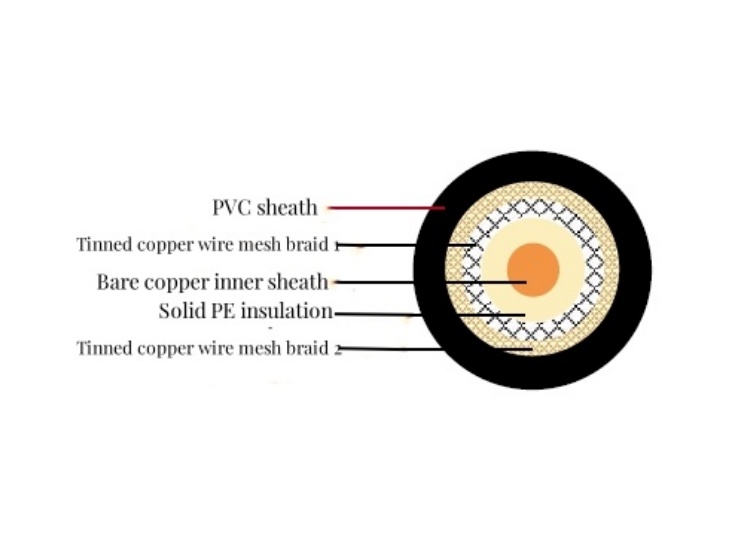
BT3002 Coaxial Cable (75 Ohm)
BT3002 is a 75 Ohm coaxial cable used for video and CCTV applications. Single-core versions offer tighter impedance uniformity than multi-core variants.
Impedance | 75 Ohm |
Max DC resistance (20°C) | 236 Ohm/km |
Min insulation resistance | 10 GΩ·km |
Capacitance | 67 pF/m (nom.) |
Withstanding voltage | 1,500 V DC (50 Hz, 1 min) |
Crosstalk (between two coaxials) | 80 dB |
Operating temperature | −25 °C to +70 °C |
RoHS | Compliant |
Models: BT3002 single-core, BT3002 8-core, BT3002 16-core
Coaxial Cable Applications
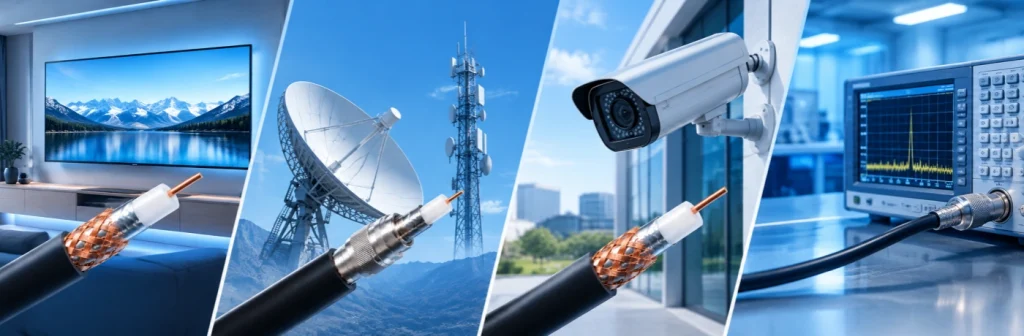
CATV & Broadband Distribution
RG6 and RG59 75 Ohm coaxial cables are the standard for cable TV, broadband internet, and satellite TV distribution. Foam polyethylene dielectric provides low signal loss over long cable runs (up to 500 m without amplification). Used by MSOs (multiple system operators), ISPs, and hospitality networks worldwide.
RF & Microwave Communications
50 Ohm coaxial cables — RG58, RG213, and hardline feeder (1/2″, 7/8″, 1-5/8″) — connect transmitters to antennas at cellular base stations, broadcast towers, and microwave links. Low-loss foam dielectric and braid shielding minimize signal attenuation and interference.
CCTV & Security Systems
RG59 and RG6 75 Ohm cables carry analog HD video and PTZ control signals from security cameras to DVRs/NVRs. RG59 is standard for shorter runs (up to 300 m); RG6 for longer runs. Triaxial cable (triax) is used for high-end PTZ cameras where video and control share one cable.
Test & Measurement Equipment
Precision 50 Ohm cables (RG142, RG223, RG316) connect test instruments — spectrum analyzers, signal generators, network analyzers — to devices under test. Stable impedance, low VSWR, and double-shield construction ensure measurement accuracy. Semi-rigid cables (RG402, RG405) are used for fixed internal connections in RF assemblies.
50 Ohm vs 75 Ohm Coaxial Cable — Which Do You Need?
The impedance of a coaxial cable must match the connected equipment to minimize signal reflection. 50 Ohm is standard for RF and two-way radio; 75 Ohm is standard for video and CATV. Using the wrong impedance causes signal loss and poor performance.
\ | 50 Ohm Coaxial Cable | 75 Ohm Coaxial Cable |
|---|---|---|
Primary use | RF, two-way radio, antenna feeders, test equipment | CATV, CCTV, video distribution, satellite |
Typical models | RG58, RG142, RG213, RG223, RG316, 1/2″–1-5/8″ feeder | RG6, RG59, RG11, RG7, triax (tri-RG59) |
Transmitters / equipment | Radio transmitters, VSWR bridges, signal generators, spectrum analyzers | TV headends, CCTV DVRs, modems, satellite receivers |
Power handling | Higher (best compromise between power and loss) | Lower (optimized for voltage standing wave) |
Dielectric | Polyethylene (solid or foam) | Foam polyethylene (lower loss at video frequencies) |
Common applications | Cellular base stations, walkie-talkies, WiFi antennas, RF labs | Cable TV, security cameras, HD video, satellite dishes |
Standard | MIL-DTL-17 | SCTE, ICEA, ASTM |
Unsure which impedance you need? Send us your equipment type or application, and we will recommend the right cable.
Why Choose Our Coaxial Cables?
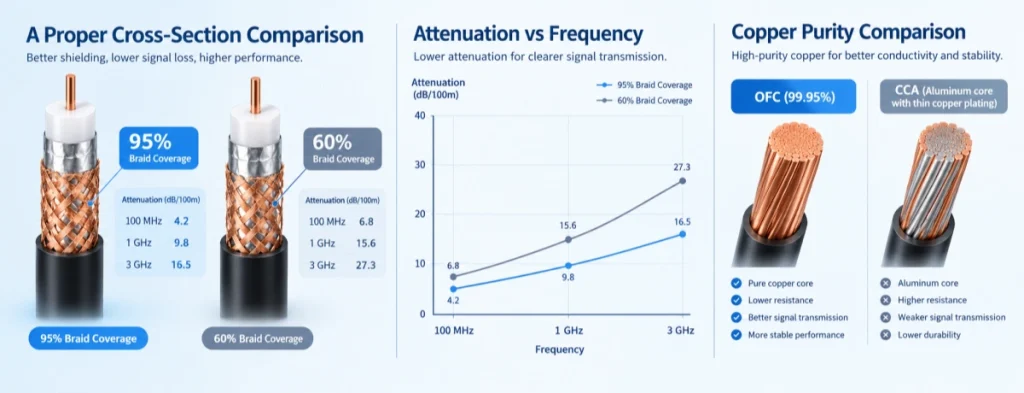
Oxygen-free copper conductors. We use bare or tinned oxygen-free copper (OFC) for center conductors and shields, ensuring lower DC resistance, better conductivity, and longer signal life compared to CCA (copper-clad aluminum) alternatives.
High-coverage braid shielding. Standard braid coverage is ≥90% (up to 95% on RG213/RG142), with options for double braid or copper foil + braid for superior noise rejection in high-interference environments.
Controlled impedance. Every batch is tested for characteristic impedance (50 Ω or 75 Ω) to ±2 Ω tolerance, ensuring consistent signal reflection and minimal VSWR across the reel.
Custom configurations. We offer custom jacket materials (PVC, PE, LSZH, FEP), armor (SWA for direct burial), dual-coax, and mixed coax + power configurations to match your installation requirements.
Full test documentation. Each shipment includes attenuation, capacitance, impedance, and high-pot test reports. Third-party inspection (SGS, BV, Intertek) available on request.
Quality Testing
Every coaxial cable batch is tested in-house before shipment. Standard tests include:
- Impedance and VSWR — characteristic impedance (50 Ω / 75 Ω) measured per reel
- Attenuation — measured at 100 MHz, 1 GHz, and 3 GHz
- Capacitance and conductor resistance — verified against MIL-DTL-17 limits
- High-pot (hipot) test — dielectric withstand voltage between conductor and shield
For LSZH (low-smoke zero-halogen) jacket options, cables additionally comply with IEC 60754 (halogen gas), IEC 61034 (smoke density), and IEC 60332 (flame retardancy). Third-party inspection (SGS, BV, Intertek) available on request.
FAQ
What is the minimum order quantity (MOQ)?
For RG series (RG58, RG6, RG213, etc.), MOQ is 500 m per model. For feeder cables (1/2″, 7/8″, etc.), MOQ is 1,000 m. Trial orders are available — contact us with your specification for a quote.
What is the difference between 50 Ohm and 75 Ohm coaxial cable?
50 Ohm cables (RG58, RG213, feeder) are used for RF transmitters, two-way radio, antenna feeders, and test equipment. 75 Ohm cables (RG6, RG59) are used for CATV, CCTV, and video distribution. Using the wrong impedance causes signal reflection and loss.
How is the cable packaged?
RG series cables are supplied on wooden or steel reels (100–500 m per reel). Feeder cables are on larger reels (up to 1,000 m). Sealed ends and customer marking on request.
Can you make custom lengths and jackets?
Yes. We offer custom cuts, PVC/PE/LSZH/FEP jackets, dual-coax configurations, and armor (SWA) for direct burial. Send us your drawing or specification.