Choosing the correct cable size is one of the most important steps when designing a solar photovoltaic (PV) system. The cable is responsible for transmitting electrical energy from solar panels to the inverter and from the inverter to the electrical grid or load.
An incorrectly sized solar cable can lead to several problems, including:
- Excessive voltage drop
- Energy loss
- Cable overheating
- Reduced solar system efficiency
- Safety risks during long-term operation
For this reason, engineers need to calculate the appropriate cable size according to the system current, cable length, voltage level, installation environment, and allowable voltage drop.
In a typical solar power system, cable sizing involves two main sections:
- DC solar cable sizing – the cable between solar panels and the inverter.
- AC solar cable sizing – the cable between the inverter and the distribution system.
This guide ZMS Cable explains how to calculate cable size for solar systems, including DC cable size calculation, AC cable size selection, solar cable size charts, and practical examples.
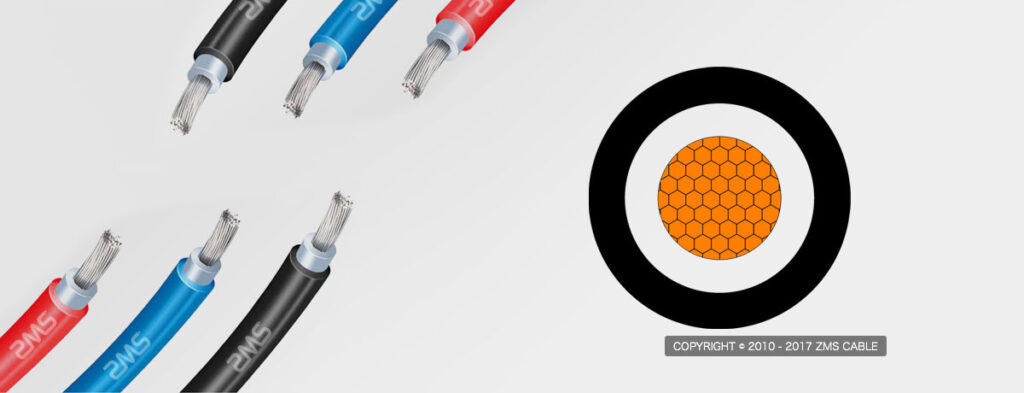
What Determines Solar Cable Size?
Solar cable size is mainly determined by several electrical and environmental factors.
| Factor | Effect on Cable Size |
| Current (A) | Higher current requires a larger conductor size |
| Cable length (m) | Longer cables require larger sizes to reduce voltage loss |
| System voltage (V) | Higher voltage allows smaller cable sizes |
| Conductor material | Copper requires a smaller size than aluminum |
| Installation method | Underground, conduit, and tray installation affect capacity |
| Ambient temperature | High temperature reduces cable current capacity |
The basic principle is simple:
Higher current + longer distance = larger cable size required.
For solar projects, engineers normally consider both:
- Current carrying capacity (ampacity)
- Voltage drop limitation
The selected cable size should satisfy both requirements.
Solar Cable Size Calculation Formula
The most common method for calculating solar cable size is based on voltage drop.
The formula is:
Cable Size (mm²) = (2 × L × I × ρ) / Vd
Where:
| Symbol | Description |
| L | One-way cable length (m) |
| I | Current flowing through cable (A) |
| ρ | Conductor resistivity |
| Vd | Maximum allowable voltage drop (V) |
For copper conductor:
ρ = 0.0175 Ω·mm²/m
For aluminum conductor:
ρ = 0.0282 Ω·mm²/m
The calculated result should then be compared with standard cable sizes, such as:
- 2.5mm²
- 4mm²
- 6mm²
- 10mm²
- 16mm²
- 25mm²
- 35mm²
How to Calculate DC Cable Size for Solar System?
DC Solar Cable Sizing Calculation
DC cables are commonly used between:
Solar panels → Combiner box → Inverter
Because solar modules generate DC power, the cable must be selected according to:
- PV string current
- Maximum system voltage
- Cable length
- Voltage drop requirement
Example: DC Cable Size Calculation
Assume a solar system has:
| Parameter | Value |
| Solar panel voltage | 40V |
| Operating current | 13A |
| Cable length | 30m |
| Maximum voltage drop | 2% |
| Cable material | Copper |
Step 1: Calculate allowable voltage drop
Voltage drop:
40V × 2%
= 0.8V
Step 2: Calculate cable size
Cable size:
(2 × 30 × 13 × 0.0175) ÷ 0.8
= 17mm²
The calculated value is approximately 17mm².
Since standard cable sizes are used, the recommended selection would normally be:
16mm² copper solar cable
However, in practical PV systems, engineers also consider:
- Cable installation conditions
- Temperature rating
- Safety margin
- Local electrical standards
Therefore, the final cable selection may be adjusted according to project requirements.
Common DC Solar Cable Sizes
Different solar applications require different cable sizes.
| Application | Typical DC Solar Cable Size |
| Small residential PV system | 4mm² |
| Residential rooftop system | 4mm² – 6mm² |
| Commercial solar project | 6mm² – 10mm² |
| Large solar farm | 10mm² – 25mm² |
| High-current PV array | 25mm² or larger |
For most rooftop solar installations, 4mm² and 6mm² PV cables are the most commonly used sizes.
For utility-scale solar projects, larger DC cables are often selected to reduce power loss over long distances.
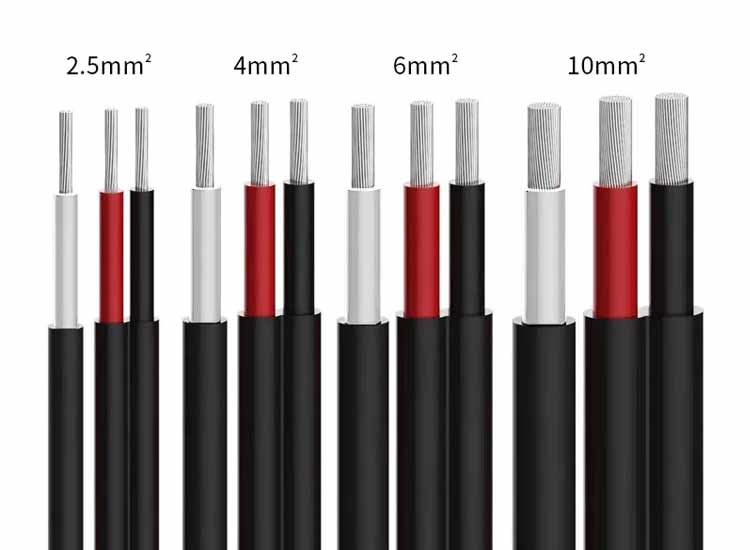
Solar Cable Size Chart
The following solar cable size chart provides general reference values.
Actual cable selection should always consider project conditions and applicable standards.
| System Current | Cable Length | Recommended Cable Size |
| Less than 10A | Less than 20m | 4mm² |
| 10A – 15A | Less than 30m | 4mm² – 6mm² |
| 15A – 25A | Less than 40m | 6mm² – 10mm² |
| 25A – 40A | Less than 50m | 10mm² – 16mm² |
| 40A – 60A | Less than 60m | 16mm² – 25mm² |
This chart is suitable for general solar cable sizing reference.
For professional PV projects, engineers should verify:
- IEC cable standards
- Installation method
- Maximum operating temperature
- Voltage drop requirements
DC Cable Size Calculator for Solar Systems
A DC solar cable size calculator normally requires several input parameters:
Required information:
- Solar system voltage
- Operating current
- Cable length
- Voltage drop percentage
- Conductor material
For example:
| Input Parameter | Value |
| System voltage | 48V |
| Current | 20A |
| Cable length | 25m |
| Voltage drop | 3% |
| Conductor | Copper |
After calculation, the recommended cable size may be:
10mm² copper DC solar cable
Online DC cable size calculators are useful for quick estimation, but professional solar projects should always verify the result according to electrical standards.
How to Calculate AC Cable Size for Solar System?
After the inverter converts DC power from solar panels into AC power, the electricity is transmitted through AC cables to the distribution panel, transformer, or electrical grid.
AC cable sizing is different from DC cable sizing because the calculation depends on:
- Inverter output power
- AC voltage level
- Single-phase or three-phase system
- Cable length
- Power factor
- Allowable voltage drop
The main purpose of AC cable sizing is to ensure:
- Safe current transmission
- Low energy loss
- Stable inverter operation
- Compliance with electrical standards
AC Cable Size Calculation Formula
For single-phase solar systems:
AC Current = Power / (Voltage × Power Factor)
For three-phase solar systems:
AC Current = Power / (√3 × Voltage × Power Factor)
Where:
| Parameter | Description |
| P | Inverter output power (W) |
| V | AC voltage (V) |
| PF | Power factor |
Example: AC Cable Size Calculation for Solar System
Assume a commercial solar project has:
| Parameter | Value |
| Inverter power | 50kW |
| AC voltage | 400V |
| System type | Three-phase |
| Power factor | 0.95 |
| Cable length | 50m |
The current can be calculated as:
Current = 50000 / (1.732 × 400 × 0.95)
≈ 76A
According to cable ampacity requirements, the selected cable should have a current carrying capacity higher than 76A.
A typical selection would be:
35mm² copper AC power cable
However, if the cable length is longer or the installation environment is more demanding, a larger cable size may be required.
DC Cable vs AC Cable in Solar Systems
Although both cables are used in PV systems, their applications and requirements are different.
| Item | DC Solar Cable | AC Solar Cable |
| Application | Solar panel to inverter | Inverter to grid/load |
| Current type | Direct current | Alternating current |
| Voltage range | 600V-1500V DC | 230V/400V AC |
| Common cable type | PV1-F solar cable | XLPE/PVC power cable |
| Main concern | Voltage drop and outdoor durability | Current capacity and protection |
| Installation environment | Outdoor exposure | Indoor/outdoor/underground |
DC solar cables are usually installed outdoors, so they require:
- UV resistance
- Weather resistance
- Ozone resistance
- Moisture protection
- Long service life
AC cables usually focus more on:
- Current carrying capacity
- Short circuit protection
- Voltage drop control
How Voltage Drop Affects Solar Cable Selection
Voltage drop is one of the most important factors in solar cable sizing.
When current flows through a cable, electrical resistance causes energy loss. The longer the cable and the higher the current, the greater the voltage drop.
Excessive voltage drop can reduce:
- Solar system efficiency
- Inverter performance
- Annual energy production
Recommended Voltage Drop Limits
| Application | Recommended Voltage Drop |
| Residential solar system | ≤3% |
| Commercial PV project | ≤2% |
| Utility-scale solar farm | ≤1%-2% |
A smaller voltage drop usually means:
- Larger cable size
- Higher initial investment
- Lower long-term energy loss
For large solar projects, selecting a larger cable size can improve return on investment by reducing lifetime power losses.
Copper vs Aluminum Solar Cable Selection
The conductor material also affects solar cable sizing.
Copper and aluminum are the two most common conductor materials used in solar projects.
| Feature | Copper Cable | Aluminum Cable |
| Electrical conductivity | Higher | Lower |
| Required cable size | Smaller | Larger |
| Weight | Heavier | Lighter |
| Material cost | Higher | Lower |
| Installation | Easier | Requires special connection methods |
| Common application | Rooftop PV, commercial systems | Large-scale solar farms |
Copper cables are widely used in residential and commercial solar systems because they provide excellent conductivity and reliability.
For utility-scale solar projects with long cable routes, aluminum cables are often selected because they provide cost advantages.
When replacing copper with aluminum, engineers usually need to select a larger conductor size because aluminum has lower conductivity.

Solar Cable Standards and Certifications
Professional solar cable selection should consider international standards.
Common solar cable standards include:
IEC 62930
IEC 62930 is one of the important standards for photovoltaic cables.
It specifies requirements for:
- Electrical performance
- Insulation materials
- Durability
- Safety performance
EN 50618
EN 50618 is a European standard commonly used for solar cables.
Cables compliant with EN 50618 are designed for:
- Long-term outdoor operation
- UV exposure resistance
- Temperature resistance
- PV system applications
When selecting a solar cable supplier, customers should check:
- Product certification
- Test reports
- Manufacturing capability
- Project experience
Solar Cable Sizing PDF: What Should Be Included?
Many engineers search for “Solar cable sizing PDF” because they need technical references for project design.
A professional solar cable sizing PDF normally includes:
1. Cable Selection Formula
Including:
- Current calculation
- Voltage drop calculation
- Cable resistance
2. Cable Ampacity Tables
Including:
- Cable size
- Maximum current capacity
- Installation conditions
3. Voltage Drop Tables
Including:
- Cable length
- Current
- Recommended conductor size
4. Solar Cable Technical Data
Including:
- Conductor material
- Insulation type
- Temperature rating
- Standards compliance
A complete cable sizing guide helps engineers select the correct cable quickly during PV system design.
Common Questions About Solar Cable Sizing
What size cable do I need for a solar panel system?
The required cable size depends on system current, voltage, cable length, and voltage drop requirements.
For many residential PV systems, 4mm² or 6mm² solar cables are commonly used. Larger commercial and utility projects may require 10mm², 16mm², or larger cables.
Is 6mm² solar cable enough?
A 6mm² solar cable is suitable for many residential and small commercial PV systems.
However, the correct size depends on:
- Current output
- Cable distance
- Installation environment
- Voltage drop requirements
How do I calculate DC cable size for solar panels?
DC cable size can be calculated using:
- Solar panel current
- Cable length
- Maximum voltage drop
- Conductor material
The voltage drop method is commonly used:
Cable Size = (2 × Length × Current × Resistivity) / Voltage Drop
What is the difference between DC and AC solar cable?
DC solar cables connect solar modules to inverters, while AC cables connect inverters to electrical distribution systems.
DC cables require strong outdoor protection, while AC cables mainly require proper current capacity and electrical protection.
Can I use a larger solar cable than required?
Yes.
Using a larger cable can reduce voltage loss and improve system efficiency.
Although the initial cable cost is higher, it may provide better long-term performance, especially for large solar projects with long cable distances.
Conclusion: Choose the Right Solar Cable Size for Better PV Performance
Correct solar cable sizing is essential for building a safe, efficient, and reliable photovoltaic system.
The key factors to consider include:
- System current
- Cable length
- Voltage level
- Voltage drop
- Installation environment
- Cable material
For DC solar cables, engineers should focus on PV string current and outdoor durability.
For AC solar cables, inverter power output and current carrying capacity are the main considerations.
By selecting the correct cable size, solar installers can reduce energy loss, improve system reliability, and maximize project performance.
As a professional cable manufacturer, we provide IEC-compliant solar cables, including DC PV cables, AC power cables, and customized cable solutions for residential, commercial, and utility-scale solar projects.
Contact our engineering team for solar cable selection support and project quotations.